TL;DR
- A floor display is priced on five specifications: tier count, the board the shelves are built from, the load each tier carries, the print, and how small the unit packs down.
- Our pages show the split: 9 of the 17 styles publish a full specification list; the other 8 publish paper type, custom size and the same seven finishing processes and stop there.
- No style publishes an MOQ or a unit price, and none prints a certificate number. Both are confirmed in writing against the drawing you approve.
A floor display is bought for one campaign and paid for three times: at the die, at the press and at the freight forwarder. The five specifications below decide whether the unit still stands in week three, and they are the five we ask about before a quotation means anything.
What the display pages publish, and what they do not
The POP display box and floor display range lists 17 styles over two catalogue pages: four-tier shelves, rotating racks and supermarket standees among them. All 17 pages carry the same three fields — paper type listed as paperboard, custom size accepted, and one seven-step list of finishing processes. What separates them is depth: 9 of the 17 carry a specification FAQ covering materials, load per tier, assembly, transit packing and timing, and the other 8 stop at the structured fields. None publishes an MOQ or a unit price, which is why the range is quoted by structure, size and print.
The sibling counter display boxes are built and quoted the same way, and we cover the production side of that family in how counter display boxes are made.
The five specifications, side by side
| Specification | What our pages publish | What it changes on the quote |
|---|---|---|
| Tier count and height | Height, width and number of tiers adjustable, stated on 9 of 17 pages (53%) | Every added tier raises the blank size and the sheet count; a taller side panel is a new die |
| Board build | B-flute or BE-flute corrugated board and thick honeycomb paperboard, named on 8 of 17 pages (47%) | A double-wall board such as BE-flute uses more liner and more fluting paper than a single wall |
| Load per tier | 15 kg to 50 kg per tier on 8 pages; 5 kg to over 50 kg per tier on 1 page; metal reinforcement bars named on 8 pages | Load is what forces the board grade and any steel bar inside the shelf |
| Print and finishing | Offset for bulk runs and digital for small runs on 8 pages; the same 7 finishing processes on 17 of 17 pages (100%) | Coverage, colour count and each finishing pass |
| Flat-packing and assembly | Flat-packed in reinforced export cartons with tool-free assembly, on 9 of 17 pages (53%) | The packed carton size is what you pay freight on |
| Sampling and production | Samples within 7 days and mass production 15–25 days after design approval, on 9 of 17 pages (53%) | Sets the date you must approve artwork and the die |
Tier count and height
The pages state that height, width and tier count are adjustable, and the four-tier unit is the format asked for most often — one style names it in the 4-tier pop-up stand itself. The cost consequence is not linear: a fifth shelf adds a blank, and it also adds height to the side panel, which means a new die, a longer sheet and often a different pallet pattern. On a floor unit the base takes the load into the ground, so height is a structural line item before it is an aesthetic one.
Board build
Where the pages go into material, the answer is high-strength corrugated board, written as B-flute or BE-flute, plus thick honeycomb paperboard for heavier units. Those letters are industry designations: the FEFCO Code, developed by FEFCO and adopted by ICCA, is the common reference for writing board constructions down (FEFCO Code, checked 30 Sep 2026). A BE-flute board carries two flutes and extra liner plies compared with single-wall B-flute, so it costs more per square metre and weighs more per unit shipped; honeycomb paperboard goes the other way on weight while keeping rigidity.
This is the first place to cut cost, and we will say so. If each tier holds under five kilograms and the display runs two weeks in one store, single-wall corrugated is enough. Double wall plus steel reinforcement is for the aisle where the stock is dense; paying for the heavy build on a short promotion is the most common way we see a display budget wasted.
Load per tier
Nine of the 17 pages publish a load figure: eight state that each tier safely supports 15 kg to 50 kg, and one states the unit can be designed to hold from 5 kg to over 50 kg per tier. Eight pages mention metal reinforcement bars inside the shelves for extra-heavy products. Read those figures as a design envelope, not a tested rating, and this is the part we would rather be blunt about: the pages do not say which test the number came from, and a design envelope is not a certificate. If your buyer needs a tested figure, the industry's own method list is where that conversation should go — it includes No. 50 compression resistance, No. 51 vertical impact by dropping and No. 52 vibration at fixed low frequency (FEFCO testing methods, checked 30 Sep 2026).
On our side the load path decides the panel: the shelf carrying the stock has to hand the load down through a continuous vertical member into the base, which is why a reinforcement bar or a doubled side panel appears in the quote for heavy units and nowhere else.
Print and finishing
Eight pages state that we print offset for bulk orders and digital for small runs, and all 17 list the same seven finishing processes: matt lamination, varnishing, stamping, embossing, glossy lamination, UV coating and gold foil. Print does not change the load a display carries, but it changes what the display survives: a laminated or UV-finished panel takes scuffing in a busy aisle better than an uncoated one. Finishing also changes composition — foil stamping and film lamination turn a board panel into a mixed-material panel, which matters if your customer's compliance team reviews material composition.
Flat-packing, assembly and landed cost
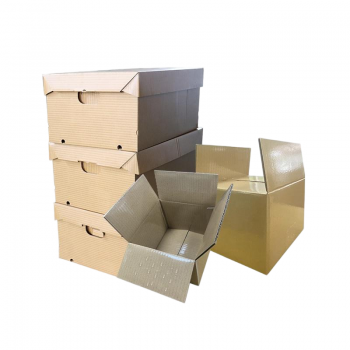
Nine pages state that units are flat-packed in reinforced export cartons with tool-free assembly. That sentence is a freight decision. A 40 ft high cube container is quoted by equipment makers at 76.3 m³ of internal cubic capacity, 2.597 m door opening height and 28,600 kg maximum payload (iContainers, 40ft High Cube dimensions, citing tabulated equipment specifications, checked 30 Sep 2026). Treat those as an equipment example and run your own arithmetic: units per container = container cubic capacity × practical fill factor ÷ packed carton volume, with door height and payload checked separately. If the arithmetic is tight, the answer is usually a smaller packed carton, not a cheaper board.
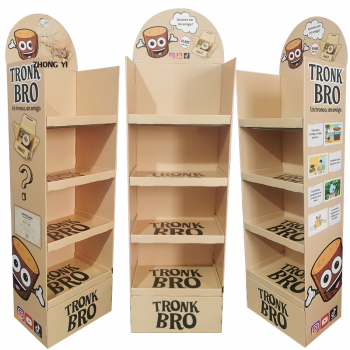
Four-tier floor display in kraft corrugated, printed for the customer's campaign.
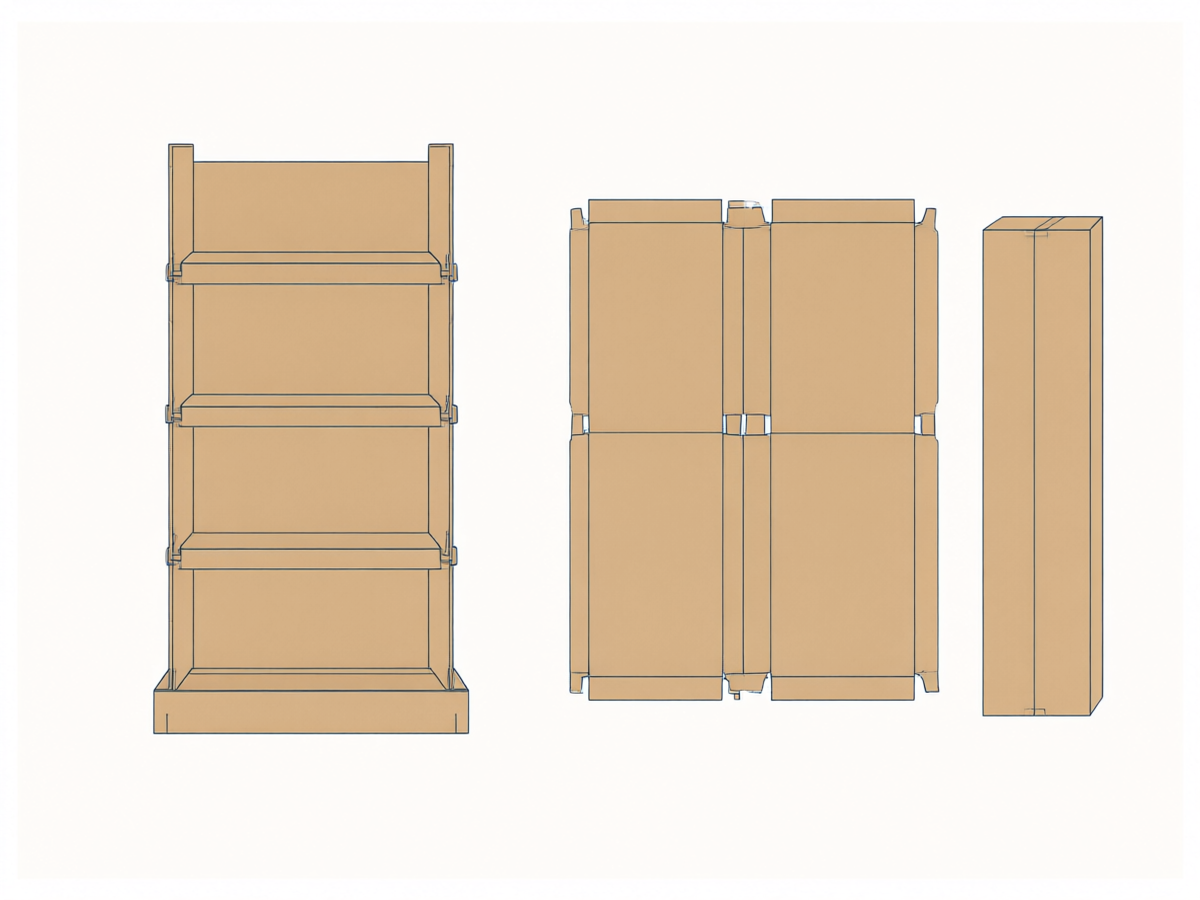
Illustration, not a photograph: the same unit assembled, collapsed flat, and in its export carton.
Certificates and the paperwork question
Eight of the 17 pages state that materials are FSC, SGS and RoHS compliant. What none of them print is a certificate or licence number, and we are not going to type one in to make a listing look complete. Here is the check your team can run instead: FSC certificate and licence codes are publicly searchable by keyword or country in the FSC certificate search (checked 30 Sep 2026), so any number we send can be verified without asking us again. Ask for documents by style and construction; if a document does not exist for the build you want, we say so before the order.
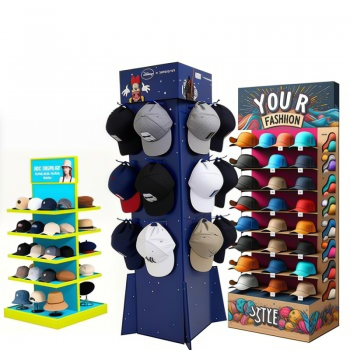
Rotating racks from the same range. Rotation changes the base and the load path, so it is quoted from the drawing.
What we need before the quote
Send five things and the quotation stops being a range: tier count and assembled height; product weight per tier and how the stock is loaded; the board build or the load case you have to meet; print coverage plus any finishing; and the destination with the store's floor footprint. Sampling is 7 days and mass production 15 days from artwork and die approval, which is the figure we work to and the one confirmed on your order; where a page or a chat message quotes a different production range, the written confirmation on the order binds. A quotation stays valid 7 days from issue. Our checklist on what we need before a die is cut applies to floor units as much as to counter units.
Questions we get on floor displays
What does a four-tier floor display cost? We publish no unit price for this range: cost moves with die size, board build, load case, print coverage and packed carton volume. Send those five inputs and the figure we quote holds for 7 days.
What is the MOQ for a floor display? None of the 17 styles publishes an MOQ, so we will not quote a range-wide number. MOQ is confirmed per structure and size, in writing, with your quotation.
How much weight can each shelf take? Eight pages publish 15 kg to 50 kg per tier and one publishes 5 kg to over 50 kg per tier. Those are design envelopes, not tested ratings; if you need a tested figure, tell us the load case and we will sample and test it.
Which board suits a heavy display? The pages name B-flute or BE-flute board for heavy-duty units and thick honeycomb paperboard where rigidity matters more than thickness. If each tier holds under five kilograms, single-wall corrugated is usually cheaper and we will say so.
Can I get a sample before the campaign is booked? Yes. Samples run 7 days and mass production 15 days from artwork and die approval, so the approval date matters more than the enquiry date.
Do the displays ship assembled? No. Nine of the 17 pages state that units are flat-packed in reinforced export cartons with tool-free assembly, and the packed carton is what freight is charged on.
Are the displays FSC certified? Eight pages state FSC, SGS and RoHS compliance and no page prints a certificate number. Ask for the declaration by style and verify any number we send in the FSC public certificate search.
Sources
- FEFCO Code for corrugated board constructions (linked above), checked 30 Sep 2026.
- FEFCO testing methods, including No. 50 compression resistance, No. 51 vertical impact by dropping and No. 52 vibration (linked above), checked 30 Sep 2026.
- iContainers, 40ft High Cube dimensions — 76.3 m³, 2.597 m door opening, 28,600 kg payload (linked above), checked 30 Sep 2026. Equipment example only.
- FSC certificate search (linked above), checked 30 Sep 2026.
- Birtleypack display pages, counted 30 Sep 2026: 17 styles; specification FAQ on 9 pages; B-flute or BE-flute and honeycomb on 8; 15–50 kg per tier on 8, 5 kg to over 50 kg on 1; flat-pack on 9; FSC, SGS and RoHS statement on 8; no MOQ or unit price.
- Load path and packing behaviour: our own production experience on this range.
- Last verified: 2026-09-30, Birtleypack content team.
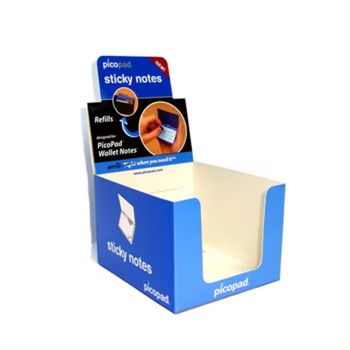
BDL Hot New Portable Small Cardboard Paper Counter Packaging Box
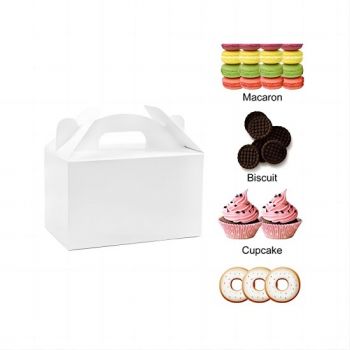
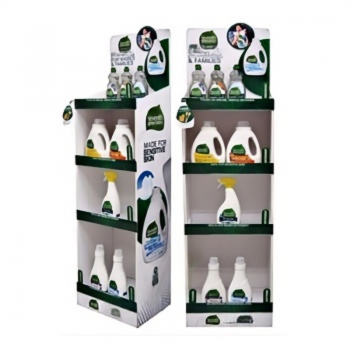
BDL 4-Tier Cardboard Floor Display with Custom Printed Logo
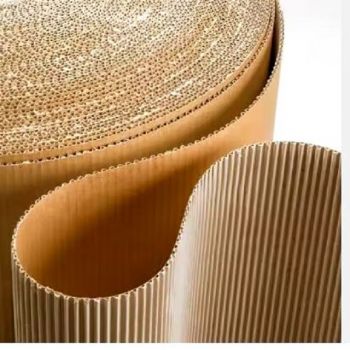
BDL Single face Corrugated Cardboard Rolls