This page is for buyers who have a counter display drawn on screen and want a firm sample date. We build counter units, PDQ trays and floor displays in Xiamen from paperboard and corrugated sheet. Before a die is cut we need six answers, and the fourth one is the one buyers most often leave out.
TL;DR
- The counter display collection lists 22 product pages: countertop shelves, PDQ trays, soap and cosmetic stands and pre-roll display boxes. Every one of them is cut from a die we make for the order.
- Six answers start that die: internal shelf size, load per shelf, board and flute, print handling, quantity, and how the unit ships. Internal size is the field buyers most often replace with a photograph.
- Sampling is 7 days and mass production 15 days from artwork and die approval. The general order quantity published on our site is 500 pcs, and a quote stays valid 7 days.
What the counter display collection holds
The counter display box collection is the countertop end of our display work: single-shelf and two-shelf units, PDQ trays, hooks-and-shelf combinations, and small stands for cosmetics, soap, and pre-roll packs. If your unit stands on the floor instead, the larger formats are in the POP and floor display range, and the printed display panels and racks we cut for shops sit in the display box collection.
What they share is that the structure, not the printing, decides whether the display survives the shop. A counter unit is loaded once by a merchandiser and then pushed around a store for three months. The die we cut has to survive that, which is why we ask for load and shelf dimensions before we talk about artwork.
Six answers we need before a die is cut
| Answer | What we need from you | Figure we work to |
| Internal shelf size | length × width × height of the loaded pocket, in mm | cut to your drawing |
| Load per shelf | weight of the product in each pocket, in kg | quoted per load, not per box size |
| Board and flute | whether the unit is paperboard or corrugated | quoted per structure and shelf span |
| Print handling | which panels are printed and which faces stay unprinted | matt or gloss lamination, varnishing, stamping, embossing, UV coating, gold foil — the finishes listed on our display pages |
| Quantity | pieces per size | the general figure published on our site is 500 pcs |
| Sample | — | 7 days from artwork and die approval |
| Mass production | — | 15 days from artwork and die approval |
| Quote validity | — | 7 days from the date we issue it |
| Styles already listed | 22 product pages | counted 25 September 2026 |
The fourth answer on that list is the one that costs buyers a week. Sending a photograph of the product tells us the shape; it does not tell us whether the pocket needs 2 mm of clearance or 8 mm, and it does not tell us whether the shelf is carrying 120 g of soap or 1.2 kg of glass. Both change the flute, the score position and the number of locking tabs.
Reading the dieline we send back
A die line is a flat drawing of a three-dimensional object. Ours carries four kinds of information: cut lines, where the board is severed; score lines, where it folds; glue flaps and locking tabs, where the unit holds itself together; and the printed panel boundaries, with bleed outside them. If you have not worked from one before, the mechanics are described in our note on what a dieline is in packaging, and the counter display file we send adds one thing a plain box does not have: the shelf and pocket layout, drawn to the load it will hold.
Two requests come back to us most often at this stage. One is artwork supplied as a flat JPEG, which cannot be placed on a die line because the fold positions are unknown; send vector artwork (AI, PDF or EPS) with fonts outlined. The other is a shelf drawn to the internal width of the product with nothing added. Paper has thickness and folds take up room, so a 95 mm-wide product in a 95 mm pocket is a jammed display; the die line is where that gap gets decided, not the artwork.
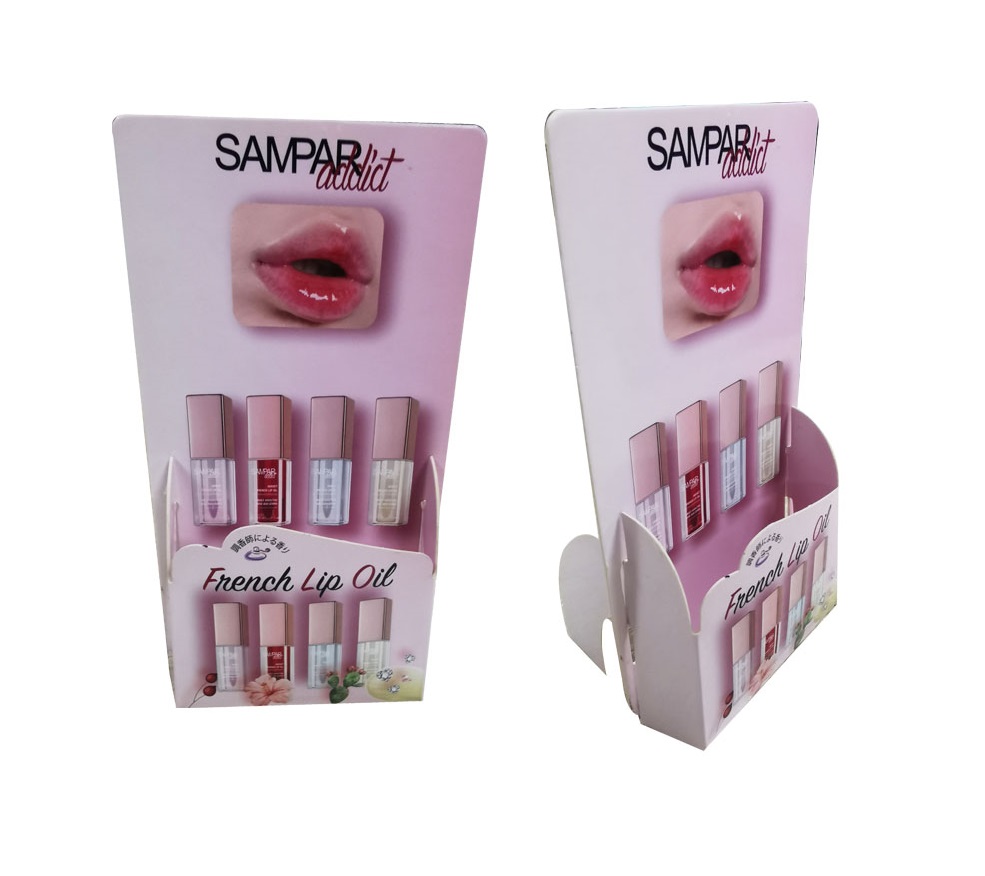
Countertop cosmetic display stand, cut from a die made for the order. Product photo, Birtleypack.
The approval loop, and what you approve
Between the first drawing and the first shipment there are three checkpoints, and each one answers a different question.
Digital proof. You approve the artwork and the die line as drawings. This is the cheapest place to move a shelf 5 mm, and it takes a day rather than a week.
Structural sample. We cut and glue the unit in an unprinted or single-colour board so you can build it, load it and put it on a bench. This is where the fold sequence gets tested by someone with the real product in hand.
Production sample. The printed unit, from the production die, before the run continues. If it passes, the run has already started; if it fails, we are still at the beginning.
The paper packaging articles cover the material side of these decisions — flute, board and print — and the sample and die approval that everything else waits on are the two dates we hold to: 7 days for the sample and 15 days for production, both counted from the moment artwork and die are approved.
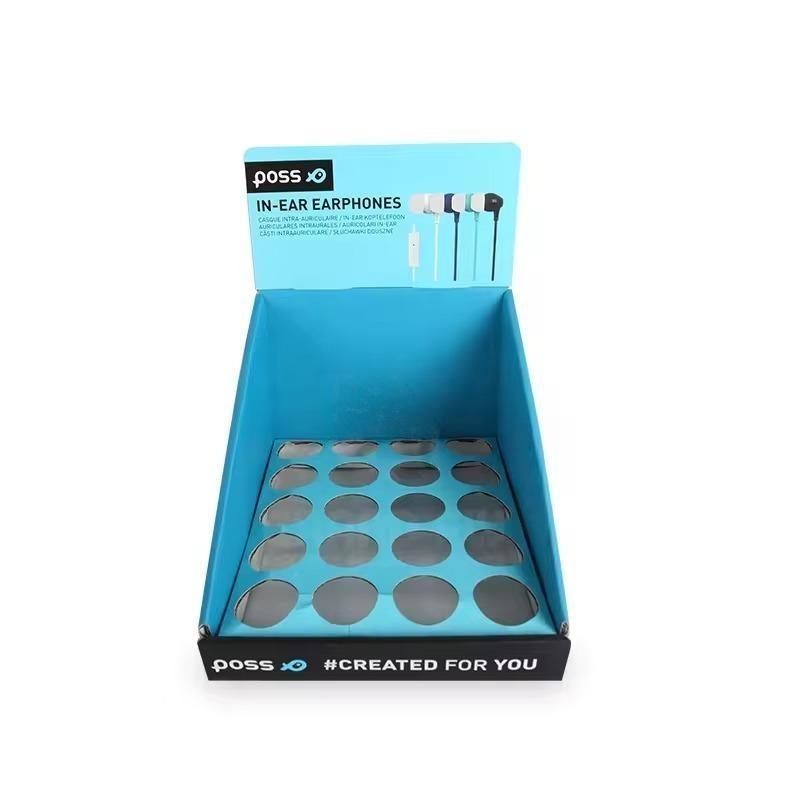
Corrugated counter display stand built for bar soap. Product photo, Birtleypack.
Where counter displays fail
Displays break in the same four places, and all four are structural. The bottom shelf bows when the load is heavier than the sample we were told about. The feet are too narrow, so the unit tips the first time a shopper leans on it. The locking tabs loosen after the second assembly, which matters because most counter displays are shipped flat and built in the store. And the shelf notches do not match the retailer's shelf edge, so the unit sits proud of the row.
We can only design against the first of those unless you tell us about the others. If you know the retailer's shelf depth, the peg pitch or the maximum stacked load, send it with the enquiry; a display that fails the retailer's own spec is a full run of board.
When we tell you not to cut a die
Three cases where a die is the wrong first move. If you need a few hundred units for a single promotion and the structure is close to something standard, a stock display with a printed header card will reach the shelf faster and cost less than tooling. If your product is not final — the pack size is still moving — wait, because the die is cut to the pocket, and a pocket change is a new die. And if you only need a display to shoot a product photograph, we can send a plain sample rather than a printed run, which is also the honest way to see whether the structure works before anyone pays for print.
One claim we will not put on a display without checking. If your artwork carries a recyclability or recycled-content statement, the wording has to hold where you sell: Regulation (EU) 2025/40 sets the EU packaging framework and places its duties on the company putting packaging on that market. We do not give legal advice, so match the claim to the market before we print the panels.
What we send with the quote
With the six answers in hand we return the die line, a quote on the Incoterm you asked for, a sample date and a production date. If the structure is new, the sample is cut and approved before the production run starts. If it is close to a display we have already made, ask whether the existing die can be adapted — that answer can save both the tooling cost and the sampling week.
Frequently asked questions
What do you need before cutting a die for a counter display? Six things: internal shelf dimensions, load per shelf, board and flute, print handling, quantity, and how the unit ships. Internal dimensions in mm and the weight in each pocket are the two that change the structure most.
How long does a display sample take? Seven days from approval of artwork and the die line. Mass production is fifteen days from the same point. Freight and booking are separate.
Can you make a display size that is not listed? Yes. Displays are made to the customer's own shelf and pocket layout, so the 22 styles in the counter display collection are examples rather than a size list.
What board do you use for a counter display? Paperboard and corrugated sheet, quoted per structure and shelf span. The board follows the load and the span between supports, not the budget alone.
Can a counter display be shipped flat? Yes, and most are. The unit is supplied flat with locking tabs or a glued base, then built in the store, which is why we test the fold sequence on the sample before the print run.
What order quantity applies? The general order quantity published on our site is 500 pcs. A display with several pockets and a large print area is quoted per size and structure, so send the quantity you need per sku and we will confirm.
Do you print the retailer's own branding on the display? Yes. Send vector artwork with fonts outlined and tell us which panels are printed; unprinted faces are quoted separately because they change the print pass.
Sources
- Birtleypack, Counter Display Boxes collection and the display product pages named above (style count, print handling options, board type, sample and order quantity wording) — birtleypack.com, counted and checked 25 September 2026.
- EUR-Lex, Regulation (EU) 2025/40 on packaging and packaging waste — checked 25 September 2026.
- European Commission, Packaging waste topic page — checked 25 September 2026.
- Sample, production and quotation validity windows confirmed with our export team on 22 September 2026.
Last verified: 25 September 2026, Birtleypack content desk (Xiamen Birtley Industry & Trading Co., Ltd.).
BDL Fanfold Continuous Corrugated Cardboard For E-commerce
BDL 96OZ Drink Takeaway Box and Bag in Box for Hot Coffee
BDL Durable Corrugated Mailer Boxes For Beauty Goods Express Delivery
BDL Custom Printed Cardboard Cake Box Personalized Cake Box With Handle
BDL Manufacturer Supply Corrugated Honeycomb Cardboard Display