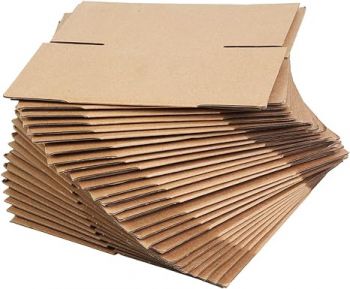
Buyers asking what a food and beverage box costs per unit usually hear "it depends" and nothing else. Below are the numbers we publish on our own product pages: unit price bands, MOQ, sample and production windows, and the four variables that move the figure before any volume discount.
TL;DR
- Of the 159 items in our food and beverage packaging collection, 113 carry a published unit price and 46 are quoted per structure. Prices run from US$0.08 to US$2.00 per piece: wax-coated cold-chain cartons sit at the top of the range, plain small pizza cartons at the bottom.
- MOQ printed on our product pages is 500–1,000 units for folding and corrugated boxes and 300–1,000 units for rigid boxes. Samples take 7 days, mass production 15 days, counted from artwork and die-line approval, and a quotation holds for 7 days.
- Four things decide the unit price before quantity does: board grade, flute, structure and internal size, and the print and finishing set. Send those four plus a quantity and the number you get back is comparable.
The price bands published on our food and beverage boxes
We do not work from one price list. Every SKU is priced on its own product page, and the spread is wide because the boxes are not comparable: a wax-coated shrimp carton and a plain kraft pizza box share a warehouse, not a cost structure. The table counts every item in the food and beverage packaging collection as it stood on 2026-09-23. Some product pages print the range in abbreviated form, so the bands below are the normalised reading of those published ranges.
| Published unit price | Items | Share of the 113 priced items | Product line it mostly covers |
|---|---|---|---|
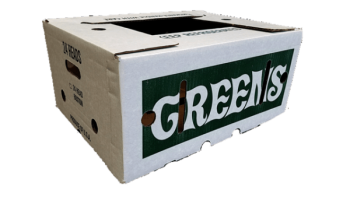
| US$0.50–2.00/pcs | 61 | 54.0% | Wax-coated seafood, chilled meat and frozen food cartons |
| US$0.50–1.50/pcs | 20 | 17.7% | Ventilated fruit and vegetable cartons |
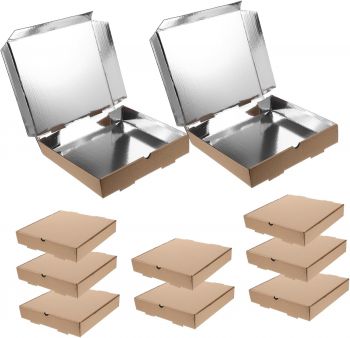
| US$0.20–0.80/pcs | 13 | 11.5% | Kraft and foil-lined pizza boxes |
| US$0.09–0.78/pcs | 10 | 8.8% | 3 L beverage bag-in-box |
| US$0.50–1.00/pcs | 5 | 4.4% | Fruit and vegetable cartons in smaller sizes |
| US$0.08–0.20, US$0.30–0.70 and US$0.30–1.50/pcs | 4 | 3.5% | Plain pizza cartons and mixed produce boxes |
| No published price, quoted per structure | 46 | 29% of the 159 items | Cake, pastry and dessert boxes, mostly |
Shares are rounded to one decimal, so the column does not add to exactly 100. Cake, pastry and dessert is the biggest block we leave unpriced, because a window patisserie carton and a plain cake board do not share enough structure to sit behind one number. Those items come back as a quote against a drawing; the cake, sushi and sandwich box collection shows the structures involved.
Four variables that move the unit price
Order quantity is the last lever, not the first. These four decide whether a box lands near US$0.15 or near US$1.40 before we discuss volume at all.
| Variable | What our product pages publish | Direction it pushes the price |
|---|---|---|
| Board grade | Kraft board, white board, CCNB/grayboard | White and coated grades cost more than kraft at the same caliper |
| Corrugated flute | E, B, C and BC flutes, plus heavy-duty stacking grades | More layers and heavier liners raise material cost per box |
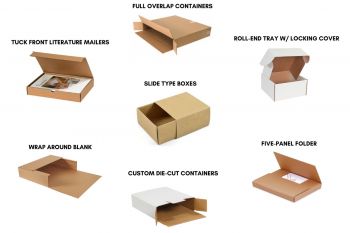
| Structure and internal size | Slotted (RSC), folders, die-cut and rigid constructions | Extra die work and hand assembly cost more than a plain slotted carton |
| Print and finishing | Offset, flexo and digital printing; matt or gloss lamination, varnish, foil, embossing, spot UV | Each finishing pass is a separate machine run |
| Order quantity | MOQ 500–1,000 units folding and corrugated, 300–1,000 units rigid | Quantity spreads plate and setup cost per piece, not material cost |
Internal size is easy to underestimate. Published sizes in this collection run from a 14 × 10 × 6 cm beverage dispenser carton up to a 12 × 12 × 6 in cake box; once a box grows past its die, the sheet layout on our line changes and yield per box drops with it.
One warning about the bottom of the table. If your product is sold as a branded retail unit and needs full-colour inner printing on a laminated surface, the US$0.08–0.20 band is the wrong shelf. That money buys a plain kraft carton with one-colour print; asking for a laminated, foil-stamped version at that price only gets a thinner board than you specified. Buyers in that position should start from a die-cut or rigid structure, where published bands begin around US$0.50. Our pizza box collection carries a worked example at US$0.20–0.80/pcs for a foil-lined box, which is where the low band genuinely lands.
MOQ, samples and production in one place
These are the numbers buyers ask for most often, in the form we are willing to put behind them.
| Item | Figure | Basis |
|---|---|---|
| MOQ, folding and corrugated boxes | 500–1,000 units | Product page FAQ |
| MOQ, rigid boxes | 300–1,000 units | Product page FAQ |
| Sample lead time | 7 days | Business confirmation 2026-09-22, from artwork and die-line approval |
| Mass production | 15 days | Same confirmation, not tiered by quantity |
| Quotation validity | 7 days | From the date the quotation is issued |
Treat the 7 and 15 as planning figures: they start when artwork and the die line are signed off, not when the enquiry arrives, and the written quotation against your confirmed drawing governs. MOQ moves with structure — a plain slotted carton on a standard die starts at the low end, a rigid box with printed wrap and foam insert sits higher. Where the exact MOQ for your size affects the order plan, take it from the quotation rather than from a category page.
What sits outside the unit price
Two costs arrive after the unit price is agreed, and both are worth modelling before you compare suppliers.
The first is freight. Cartons are charged on volume rather than weight once they leave the pallet, so a box 2 cm deeper than the product needs can cost more across a full load than the board saving was worth. We size to the internal dimension the product actually needs, and chargeable volume comes from the outer carton's length, width and height.
The second is compliance. Regulation (EU) 2025/40 on packaging and packaging waste applies from 12 August 2026, and the European Commission's own summary states that without further measures packaging waste would grow by 19% and plastic packaging waste by 46% by 2030. That does not ban your carton. It puts weight, recyclability and empty space into fee and reporting conversations in European markets, and the obligations generally fall on the party that places the packaging on that market, which may be your importer rather than you. Whether your structure is caught is a question for your compliance adviser; our part is being able to state board grade, coating and weight per box on request. See the European Commission packaging and packaging waste page and the Commission and stakeholder platform note that the new rules are starting to apply. Coatings are the part of a food carton buyers ask about most, and the options we can discuss are set out in our note on wax-coated corrugated boxes for produce and seafood.
How to get a comparable unit price
Send these six items and the reply is a number you can put beside another supplier's, rather than a range you have to interpret:
- Internal dimensions in millimetres or centimetres, all three, in the orientation the product sits.
- Product weight per box, and whether it will be stacked or palletised.
- Board preference, or the conditions the box has to survive: chilled, frozen, damp or dry.
- Print: number of colours, coverage, and whether inner printing is required.
- Finish: none, varnish, lamination, foil, embossing or spot UV.
- Order quantity for the first run and the expected annual volume.
With those six, the quotation comes back with a unit price, an MOQ for that specific structure, and the 7-day and 15-day windows applied to your artwork date. A request for the best price on a cake box, without dimensions, returns a band, and a band is not a commitment. Background on how we build these structures and finishes is in our food and beverage packaging articles.
One more note from the production side: the sample is the cheapest place to find a sizing error. We run the die proof before the run, and a 2 mm error caught there costs a re-cut, while the same error caught after production costs the whole run. If your internal dimension is approximate, say so instead of rounding it up.
FAQ
What is the cheapest food and beverage box you sell? The lowest published band in this collection is US$0.08–0.20 per piece for plain small pizza cartons, followed by US$0.09–0.78 for 3 L beverage bag-in-box. Both are plain kraft or simple one-colour print, and any finishing or board upgrade moves them out of that band.
Why do two boxes that look the same have different unit prices? Board grade, flute and print usually differ even when the shape does not. A kraft E-flute carton and a white BC-flute carton of the same footprint are different amounts of paper, and the print passes are separate machine runs.
Do you have a price list I can download? No single list exists, and we do not publish one. Prices are set per SKU on the product page, which is why the bands above were counted from those pages. A list without dimensions, board and quantity would mislead both sides.
Is the published price per box or per piece? Per piece, and it is a range rather than a fixed figure, because one product page can cover more than one size option. The upper end of a published range is normally the largest size on that page with the standard print.
Can I get below the published band? Not by asking for a discount on the same specification. What changes the number is a lighter board where the stacking load allows, one less finishing pass, or a longer run so setup is spread further. On a plain slotted carton material cost dominates, so quantity alone will not take you under the band.
How long from confirmed order to shipment? Plan on 7 days for samples and 15 days for mass production, counted from artwork and die-line approval, plus transit. For Q4 sea freight the booking window matters more than the production days, and both figures assume the drawing is approved on the first pass rather than after revisions.
Sources
- Birtleypack product pages and the food and beverage packaging collection (159 items, price, material, MOQ and size fields), read 2026-09-23.
- European Commission, packaging and packaging waste regulation topic page, environment.ec.europa.eu.
- European Circular Economy Stakeholder Platform, "PPWR: the new rules are starting to apply", published 25 August 2026, circulareconomy.europa.eu.
- Birtleypack business confirmation of sample, production and quotation validity windows, 22 September 2026.
Last verified: 2026-09-23, content desk at Xiamen Birtley Industry & Trading Co., Ltd.
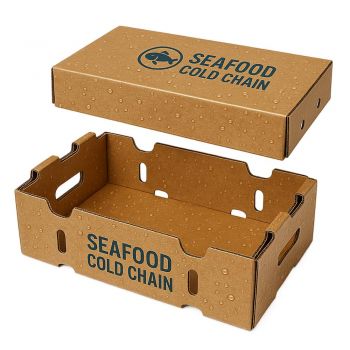
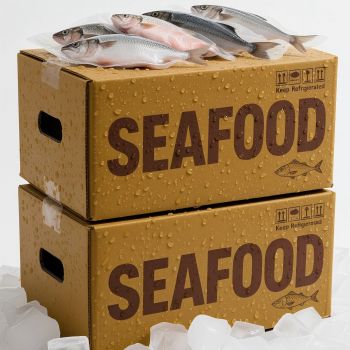
BDL Hot Selling Waterproof Waxed Corrugated Carton Custom Logo Size
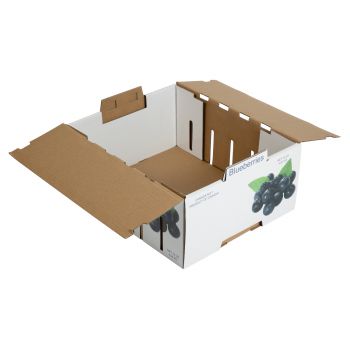
BDL Custom Cardboard Grape Fruit And Vegetable Box Package for Shipping
BDL Customized Wedding Gift Packaging Corrugated Paper Boxes