This page is for buyers who have decided to move a load off timber, foam or triple-wall board and now have to write the specification for a paper honeycomb panel. We make honeycomb sheet in Xiamen. Here are the five fields we need to quote, and what moves when you change one.
TL;DR
- The collection lists 33 product pages: plain sheet and panel forms, door and partition cores, printable display panels, cylindrical sleeves, fanfold panels and kraft rolls. Sheets are cut to your size.
- Five fields decide the panel: internal size, board thickness, core cell size, facing and bond, and the load it carries. Board thickness runs from 8 mm to 150 mm.
- Sampling is 7 days and mass production 15 days from artwork and die approval. The general order quantity published on our corrugated and folding pages is 500 pcs, and a quote stays valid 7 days.
What is listed in the honeycomb sheet collection
The honeycomb cardboard sheet collection is not a single product. It holds the forms we build from one core: kraft paper glued into a hexagon, stretched, and laminated between liners. The counts below come from the product titles on that collection page, read on 25 September 2026.
| Form | Product pages that mention it | What it is |
| Sheet and panel forms | 17 | Hexagonal core laminated between liners into a flat rigid board |
| Printable display panels | 9 | Panels printed for shop, exhibition and advertising display |
| Door and partition cores | 6 | Continuous core for interior doors, partitions and furniture panels |
| Cylindrical sleeves and tubes | 4 | Round protection for bottles, jars and cylindrical parts |
| Fanfold and continuous panels | 3 | Closed honeycomb supplied as one continuous run |
| Kraft paper rolls | 2 | Wrapped core for interleaving and void fill |
Those rows overlap: a printable display panel is also a sheet, and a door core is a panel before it is glued into the door. The collection holds 33 product pages in total. If you know the shape of the box rather than the panel, the honeycomb cardboard box range is the same core assembled into a container.
The five fields, in one table
| Field | What we need from you | Range we work in |
| Internal size | length × width × height of the finished panel | cut to your drawing, no fixed range |
| Board thickness | the thickness the job needs | 8 mm to 150 mm |
| Core cell size | the load, and whether it is shock absorption or wedging | large cell or small cell |
| Facing and bond | liner and glue system | kraft liner on both faces with water-based PVA; UF, PVA or PUR hotmelt when the core goes between your own facings |
| Order quantity | pieces per size | the general figure published on our site is 500 pcs |
| Sampling | — | 7 days from artwork and die approval |
| Mass production | — | 15 days from artwork and die approval |
| Quote validity | — | 7 days from the date we issue it |
Field one: core cell size
Two cell sizes are made, and they are not interchangeable. On the kraft honeycomb panel page we describe the split this way: the large cell absorbs shock waves and works as void filler, while the small cell is what we recommend when the item being wedged is heavy or when compressive strength is the point. A buyer who sends a photograph of a 400 kg machine skid and a buyer who sends a photograph of a lamp get different cells from us, even when the panel outline is identical.
Cell size changes the number of walls between the two liners, so it changes weight and behaviour under a point load. When you cannot describe the load, send the test we have to pass.
Field two: board thickness
The sheet pages state that we manufacture honeycomb panels from 8 mm to 150 mm thick. That range covers two different jobs. Down at the thin end the panel is an interlayer, a layer pad or a wrap; up at the thick end it is a structural filler for a door blank, a partition or a machine base.
Thicker is not automatically better. A 150 mm panel costs more per piece and takes freight volume that your container has to pay for. We have quoted a 100 mm panel for a job that later ran at 30 mm once the buyer measured the gap in the assembled machine. Measure the gap, not the panel you remember.
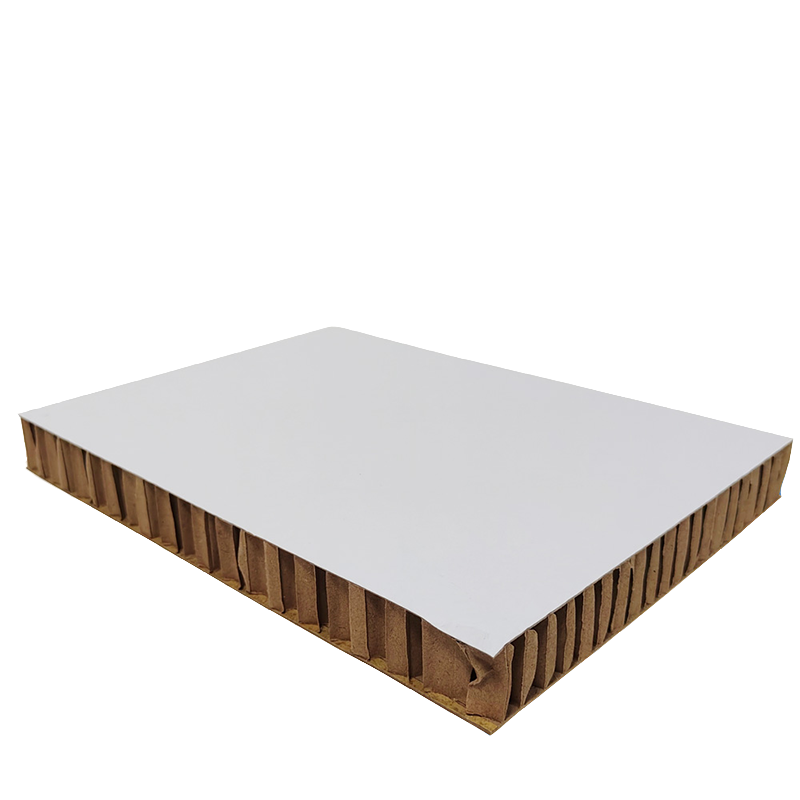
Honeycomb cardboard sheet, supplied cut to customer size in thicknesses from 8 mm to 150 mm. Product photo, Birtleypack.
Field three: facing and bond
For a finished board, paper liners are laminated with a water-based PVA glue onto the pre-stretched core, on the lower and the upper face. That is the version most buyers order, and it is the version we cut to size and ship.
Some buyers want the core only, to build their own composite panel. The door core pages list the glues that suit that route — UF, PVA or PUR hotmelt — and the facings the core is qualified against: softwood, hardboard, plywood, plasterboard, chipboard, MDF, HDF, melamine board and steel. If you are pressing your own sandwich, tell us the facing and the press you run, because that combination, not the core on its own, sets the strength of the finished panel.
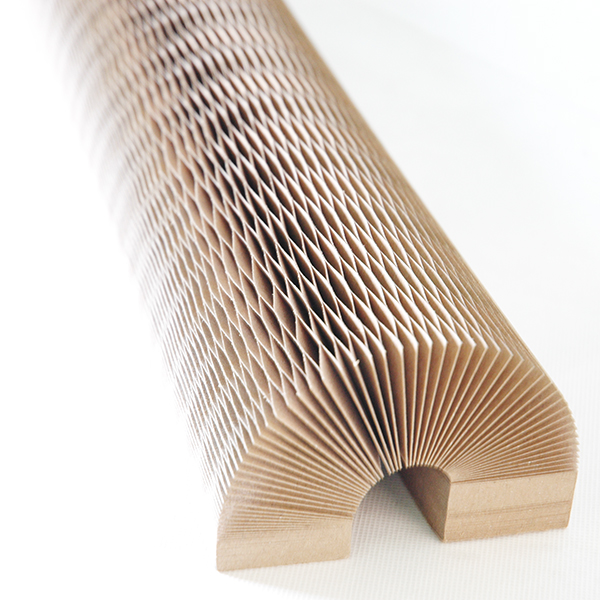
Honeycomb door filler core, supplied for interior doors, partitions and furniture panels. Product photo, Birtleypack.
Field four: sheet format and edge
The same core leaves us in five shapes: a cut sheet or panel, a fanfold continuous run, a roll, a cylinder or sleeve, and a pad. The door core pages note that the core can be supplied with or without ventilation slits or holes. That detail is invisible on a photograph and obvious in assembly, so it belongs on your drawing: if the door or the panel has to breathe, say so at enquiry stage rather than after the first delivery.
Tell us three more things with the format: whether the panel is glued into a frame or left free, which face is printed, and how the edge is allowed to look. A honeycomb edge shows the open cells, and if your client will see that edge, plan a wrap, a tape or a thicker liner before we cut.
Field five: the load, and the material it replaces
Most of these pages are bought to replace something else. The kraft honeycomb panel page describes the two common swaps: an interlayer sheet or a top pallet in place of wooden panels, and a substitute for double or triple-wall corrugated sheets when the load, the furniture or the fragile goods need more support. The door and partition core replaces solid filling in interior doors and lightweight walls. The anti-collision transport board page states compressive strength can exceed 70 PSI; treat that as the figure for that construction, and ask us for the test data of the thickness you would actually order.
Because the panel is light, the saving usually shows up in freight rather than in the board price. The arithmetic of how many sheets fit in one container, with the pallet pattern, is in our note on honeycomb sheets in a 40HQ container. Read that before you fix the thickness.
What honeycomb sheet is not for
Three jobs we will talk you out of. If the panel sits in water or constant damp with no coated or faced surface, paper honeycomb is the wrong material, and we would rather say that at enquiry stage than after a failed shipment. If you need a food-contact barrier, the core is not that barrier. And if you want fifty sheets to test an idea, a stock board from a local merchant will reach you faster and cheaper than a cut-to-size run from us.
The same caution applies to what is printed on the panel. A recyclability or recycled-content claim has to be defensible in each market you sell into, and the rules are moving: Regulation (EU) 2025/40 sets the EU packaging framework and places its duties on the company putting packaging on that market. We have not found a clause in it that singles out paper honeycomb, and we do not give legal advice; check the position for your market before the artwork is approved. More on our material position is filed under sustainability articles.
Fire-retardant honeycomb: what the page says, and what to check
Part of this collection is a fire-retardant line, made by impregnating or coating the paper with flame-retardant agents. The relevant product page states the board is tested for vertical combustion and oxygen index and cites a B1 grade under GB8624-2012 alongside ASTM fire references. That is the supplier statement published on our own page. Before you print a fire rating on a panel, ask us for the current test report and match it to the standard your market names; a grade accepted in one market is not automatically accepted in another.
What happens after you send the five fields
With internal size, thickness, core cell, facing and quantity in hand, we confirm the board construction and return a quote on the term you asked for, with a sample and a production date. The sample is the moment a wrong thickness is still cheap to change. Send three panel sizes and the load each one carries, and we will come back with a construction rather than a range.
Frequently asked questions
What thickness can you make honeycomb cardboard sheet in? The panel pages state a range from 8 mm to 150 mm. Thin panels are used as interlayers, layer pads and wraps; thick panels are used as filling for door blanks, partitions and machine bases.
Which core cell size should I choose? The small cell is recommended when the product being wedged or protected is heavy, or when high compressive strength is required. The large cell is used to absorb shock waves or as a void filler. Send the load and the stack height and we will confirm which cell we would run.
Can you cut sheets to my size? Yes. Sizes are cut to the customer's requirement, so send the internal dimensions of the panel you need in mm or inches. We do not work from a fixed size list.
What are honeycomb panels used for instead of plywood or triple-wall board? As an interlayer sheet or a top pallet over a load, replacing wooden panels or double and triple-wall corrugated sheets where the goods are fragile or heavy. Door cores, partition walls, furniture panels, printed display panels and bottle sleeves are the other uses in this collection.
How long do a sample and a production run take? Seven days for the sample and fifteen days for production, both counted from approval of artwork and the dieline. Freight and booking are separate from those figures.
What is the order quantity for honeycomb sheet? Honeycomb sheet is quoted by the sheet, and the run the board mill will take depends on thickness and panel size, so ask us with the size in hand. The general order quantity published on our corrugated and folding product pages is 500 pcs.
Can the core be supplied without liners? Yes. The door core pages list the core as a standalone material for laminating between your own facings, with UF, PVA or PUR hotmelt as the glue systems and a qualified facing list that includes plywood, chipboard, MDF, HDF, melamine and steel.
Sources
- Birtleypack, Honeycomb Cardboard Sheet And Related Products collection and the product pages named above (style counts, 8 mm to 150 mm thickness range, water-based PVA liner bonding, cell size guidance, bonding systems, facing list, ventilation slits, 70 PSI figure) — birtleypack.com, counted and checked 25 September 2026.
- EUR-Lex, Regulation (EU) 2025/40 on packaging and packaging waste — checked 25 September 2026.
- European Commission, Packaging waste topic page — checked 25 September 2026.
- Sample, production and quotation validity windows confirmed with our export team on 22 September 2026.
Last verified: 25 September 2026, Birtleypack content desk (Xiamen Birtley Industry & Trading Co., Ltd.).
BDL Custom Printed Cardboard Cake Box Personalized Cake Box With Handle
BDL Light Candle Vessels With your ideas easy To store
BDL 96OZ Drink Takeaway Box and Bag in Box for Hot Coffee
BDL Small Jewelry Paper Packaging Gift Box Girls Ring
BDL Rigid Double Door Gift Box with Magnetic Lid for Skincare
BDL Portable Carton West Point Cake packing paper box