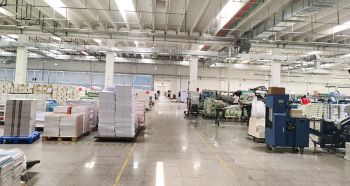
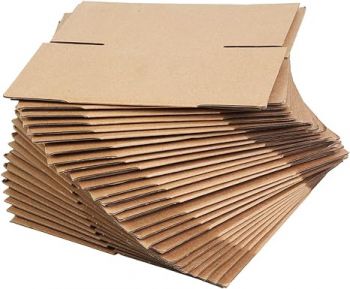
Fact-checking a general answer about bakery packaging is easier from the drawing than from the description. We cut cake, sushi and sandwich boxes in Xiamen from kraft paper, ivory board and paperboard, and most of what a generic answer gets wrong comes down to three things: the paper is chosen per item, the size is cut to your tray, and the barrier is specified rather than assumed.
TL;DR
- The cake, sushi and sandwich box collection lists 21 product pages across two collection pages, counted 26 September 2026: handle and window cake boxes, cupcake boxes with PVC windows and 6-hole or 12-hole inserts, cake boards, pastry and donut window boxes, a kraft self-erecting box and a rigid cake box.
- The papers named there are kraft paper, ivory board and paperboard; the builds are folding cartons (listed as folders), a self-erecting box and a rigid box. Ordered size reads "custom size accepted" on all 21 pages, so the listed sizes are examples, not a size chart.
- Sampling is 7 days and mass production 15 days from artwork and die approval, and a quote stays valid 7 days.
What this collection actually lists
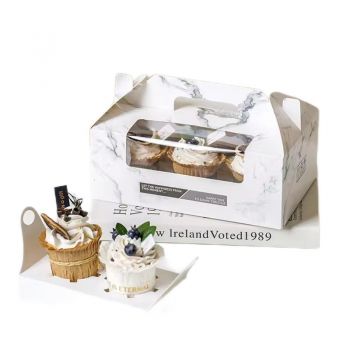
Twenty-one pages, and they are not variations of one box: handle and clear-window cake boxes, individual cupcake boxes with a PVC window, six-hole and twelve-hole cupcake carriers with a folding insert, white bakery cake boxes supplied with boards, a corrugated box for cake slices, pastry and donut boxes with a 12 inch window, and a rigid cake box with a wrapped lid. The window and the handle separate them on a shelf; the folding sequence separates them in a run.
Every page states the same two things about ordering: size is accepted as a custom size, and printing as custom print. The box is drawn around the cake board or tray you already use, and the die is made for that drawing, which makes a photograph of a cake a poor specification. The food and beverage box range holds the wider formats if your item is a pizza or a cold-chain carton.
Six quick answers we would correct
1. "All cake boxes are corrugated." Ours are mostly folding cartons cut from paperboard, ivory board or kraft paper, listed as folders on the product pages. Corrugated appears for cake slices and catering trays. A flute adds thickness, a score that wants more force, and a bigger shipping cube for the same internal size.
2. "Sushi and sandwich boxes need a coating by default." A coating is decided against the item, not the category; dry bakery items sit in uncoated board on our pages. Fat and moisture pull a barrier into the specification, so name the item and the holding time and we quote that grade rather than the most expensive one.
3. "Any window film is fine." The cupcake and cake pages here name a PVC window. PVC ends its life differently from cellulose or PLA film, and some markets treat those films differently in packaging-waste rules. Send your retail customer's film preference with the artwork: film sets the die tolerance and the glue line, so a later swap is a new sample.
4. "A 12 inch box fits a 12 inch cake." It fits a 12 inch cake board, and only when the board is what we sized against. Box dimensions are internal in our drawings, and the box needs clearance so a hand can lift the cake out.
5. "There is one standard MOQ across the range." Order quantity is quoted per style, because the build, the paper and the finishing each move it. Send the quantity per size and we confirm against the die and the print pass.
6. "Mass production takes a month." Fifteen days from approval of artwork and the die, seven days for the sample. The clock does not start at the enquiry, which is why approval dates matter more than the order date on a fixed launch.
What our cake, sushi and sandwich pages publish
| Field | What our pages publish | Why it matters in a run |
| Styles listed | 21 product pages across 2 collection pages, counted 26 September 2026 | Examples of what we have made, not a size chart |
| Papers named | kraft paper, ivory board, paperboard; board thickness quoted in mm from your drawing | The paper follows the item, the print and the handling |
| Constructions | 3 builds: folding carton (folders), self-erecting box, rigid box | A folding box ships flat, a rigid build ships assembled |
| Window | PVC window on the cupcake and handle cake styles; film cut with the die, tolerance in mm | Film choice changes the die tolerance and the market story |
| Cupcake inserts | 6-hole and 12-hole folding inserts, sized to the liner you send | Insert count sets the internal grid and the board grade |
| Board thickness | quoted from your mm drawing; a 3 mm cake board and a 6 mm board give different internal heights | The lid height and the cake clearance both move with it |
| Sizes named in listings | 4 × 4 × 2.5 in, 12 × 12 × 6 in, and a 12 in window box for pastry and donuts | Named sizes are what we have already cut, not stock sizes |
| Print handling | 7 finishes listed: matt lamination, gloss lamination, varnishing, UV coating, stamping, embossing, gold foil | Each finish adds a pass and can change the paper |
| Sampling | 7 days from artwork and die approval | The sample is what you build and load before print |
| Mass production | 15 days from artwork and die approval | Counted from approval, not from the enquiry |
| Quote validity | 7 days from the date we issue it | Paper and freight move; the date is on the quote |
| Model numbers | BDL16, BDL33, BDL37, BDL41, BDL44, BDL6003, BDL6006, BDL6011, BDL6012 | A model number is a starting point for quoting a variant |
Two of those rows decide most of the arguments we have with buyers: the window film and the ordered size. Both are written into the die, cheap to change in a drawing and expensive to change after the sample.
Where a generic answer breaks in a real run
The general answer treats a cake box as a printed cube. In our drawing it is panels with a score on each fold, a board with a thickness, and an internal dimension larger than the cake.
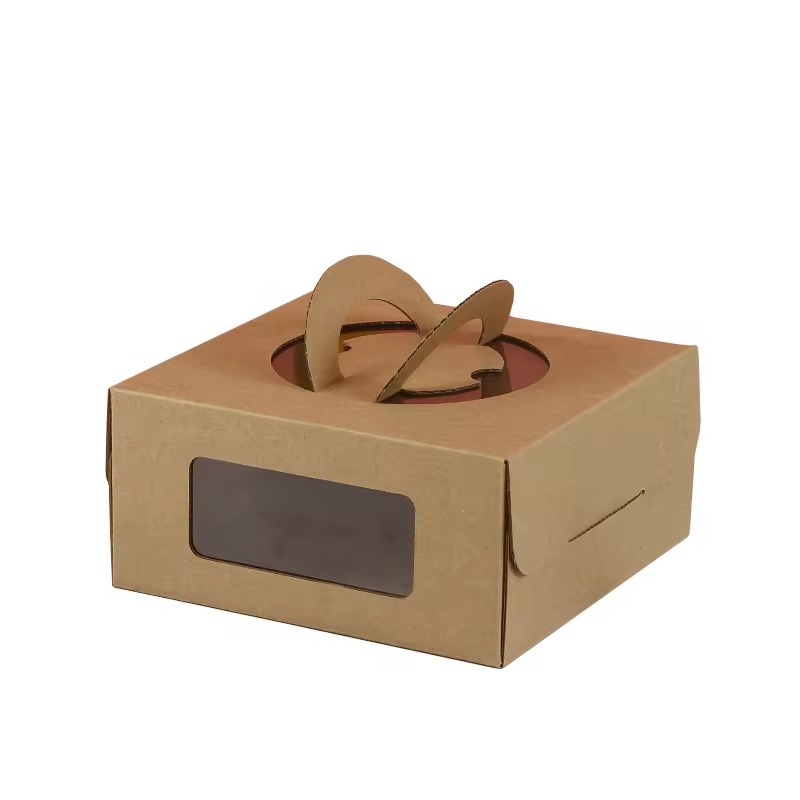
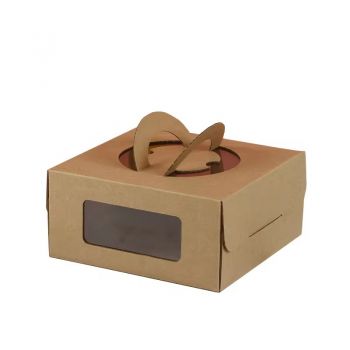
Kraft cake box with a handle and a clear window, one of the 21 styles in the collection. Product photo, Birtleypack.
The lid does not close because the board is thicker than the drawing assumed. A 3 mm board and a 6 mm board share a footprint on a drawing and give different internal heights. Send the board thickness, not only the cake diameter.
The window sits on a score. A window crossing a fold needs the film to take the fold without lifting at the corner, so die and film are cut together. If your artwork puts a window over a fold, expect a few millimetres of movement, and approve it in the drawing rather than on the sample.
The insert does not match the tray. A 12-hole insert is a grid and your baking tray has its own. Send one cupcake in its paper liner and we size the cells to it, because a cell that is a few millimetres tight tears that liner every time the box is opened.
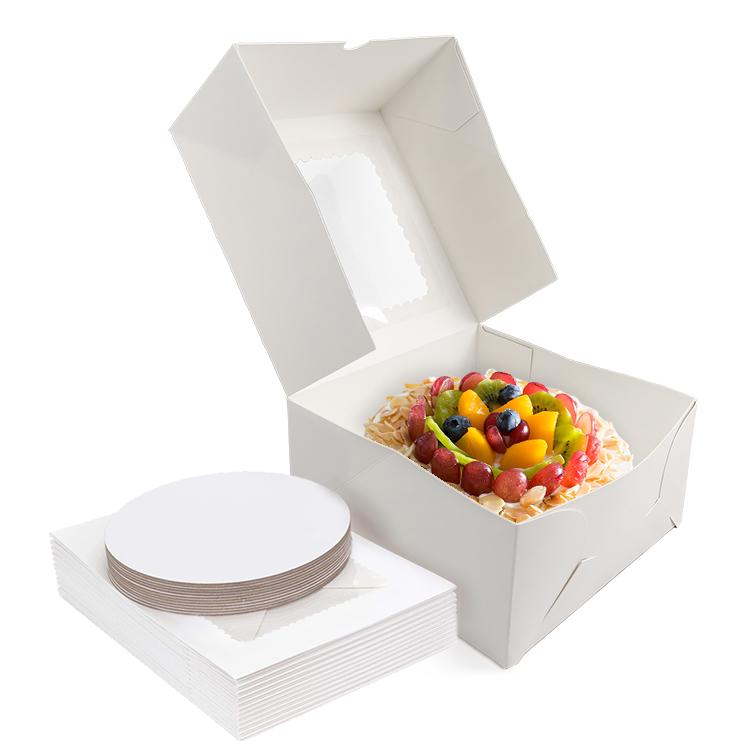
Cake box with a folding cardboard insert and a clear window, printed and cut to the customer's tray. Product photo, Birtleypack.
When we tell you not to order a custom box
Four cases where a custom die is the wrong first move, and we will say so rather than quote it.
Your cake size is still moving. The die follows the internal dimension, so a change from 10 to 11 inches is a new die and a new sample. Settle the board and the cake before you pay for tooling.
You need a few dozen units for a photo shoot or a market stall. A plain kraft box in a close size with a printed label gets there faster and leaves the tooling money for the order that repeats.
You need a barrier we cannot document for your market. If the item is wet, fatty or held for hours, the paper and any coating have to match the food-contact rules where you sell. In the EU that conversation starts at the European Commission's food contact materials pages and the framework regulation Regulation (EC) No. 1935/2004; in the United States the paper and paperboard components used in dry-food contact are listed in 21 CFR 176.180. We are a box maker, not your compliance adviser: we send the technical data and you confirm the route.
You want a recyclability or plastic-free claim printed on the panel. Not until it holds where the box is sold. Regulation (EU) 2025/40 places the duties for packaging put on the EU market on the company doing that, and the wording of a claim is part of it.
What we need to quote a cake, sushi or sandwich box
Six answers, and the first three are the ones buyers send last: the internal length, width and height in mm measured inside the box; the cake board or tray thickness in mm; the item itself and whether it is dry, damp or fatty; the quantity per size; which panels carry print; and how the box ships.
With those we return a die line, a sample date and a production date. If the format is close to one of the 21 listed styles, say which one; adapting an existing die is cheaper and faster than cutting a new one, and we will tell you which of the two it is. Our food and beverage packaging notes cover the board and moisture side of the same decisions, and for the base plate under the cake the cake board range is where it is quoted.
Frequently asked questions
Are your cake boxes greaseproof or waterproof as standard? No. The pages name the paper — kraft, ivory board or paperboard — and the box style. A grease or moisture barrier is a specified upgrade for a damp or fatty item, quoted against the item and the holding time.
Can you make a sushi or sandwich box with a coated board? Yes, when the coat is matched to the food and the market. Send the item, the holding time and the market, and we come back with the paper and coating options plus the technical data for the food-contact route.
What window film do you put on a cake box? The cupcake and cake pages list a PVC window. If you need another film or a film-free lid, say so before the die is cut, because the film and the die tolerance are set together.
How do I size a box for a cake board? Send the internal length, width and height in mm plus the board thickness. The box is cut around those numbers with clearance, so a box for a 12 inch board is not the same thing as a 12 inch box.
What is the minimum order quantity for cake boxes? Quoted per style: build, paper and finishing each move it, and a rigid wrapped box sits in a different bracket from a folding carton. Send the quantity per size and we confirm against the die and the print pass.
How long does a printed cake box take? Seven days for the sample and fifteen days for mass production from approval of artwork and the die line, with a quote valid seven days. Freight and booking sit outside those windows.
Can you print a recyclable or plastic-free logo on the box? We print artwork you have the right to use, but not a claim we cannot support in your market. Send the wording and the market, and confirm it against the rules that apply to you before the panels go to print.
Sources
- Birtleypack, cake, sushi and sandwich box collection and the 21 product pages named above: style count, papers, builds, window type, inserts, named sizes, print handling and model numbers — birtleypack.com, counted and checked 26 September 2026.
- Sample 7 days, mass production 15 days and quote validity 7 days confirmed with our export team on 22 September 2026.
- European Commission, food contact materials topic pages; EUR-Lex, Regulation (EC) No. 1935/2004; eCFR, 21 CFR 176.180 on paper and paperboard in contact with dry food; EUR-Lex, Regulation (EU) 2025/40 on packaging and packaging waste — all checked 26 September 2026.
Last verified: 26 September 2026, Birtleypack content desk (Xiamen Birtley Industry & Trading Co., Ltd.).
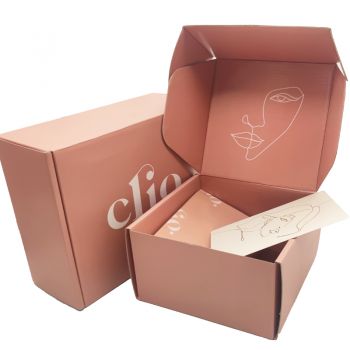
BDL Gift Mailer Box with Zipper Tear Strip and Custom Print
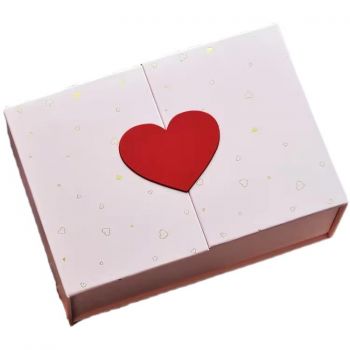
BDL Hook Carton Display Box for Pet Shop Dog Food